How much space should other languages have in English classrooms?
Across many classrooms around the world, teaching and learning rarely happen in just one language. For teachers working in multilingual contexts, this raises an important question: how can other languages be used effectively to support learning, rather than seen as a barrier?
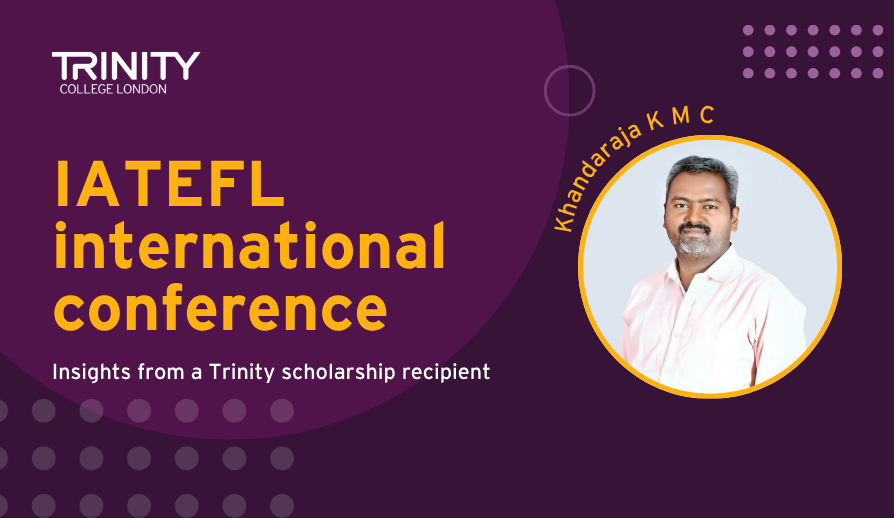
At this year’s IATEFL Conference, Trinity College London scholarship recipient Khandaraja K M C will bring this question to a global stage, sharing work shaped by real classroom experience in India.
A focus on multilingual classrooms
In contexts like India, multilingualism is a natural part of everyday learning. Students and teachers often move between languages to support understanding, even in classrooms where English is the main medium of instruction.
Khandaraja’s work builds on this reality, exploring how this can move from something informal to something more intentional and structured in teaching.
“It is more or less a spontaneous phenomenon in classrooms; teachers are already using it… but we want teachers to see it as a resource.”
From classroom reality to classroom practice
At the centre of his work is a collaborative project with teachers, focused on developing bilingual teaching materials and approaches that reflect their classrooms.
Instead of providing ready-made resources, teachers were supported to:
- adapt existing English lessons into bilingual formats
- experiment with different approaches in their classrooms
- reflect on what worked best for their students
“We encouraged teachers to develop the material... It was mostly a grounded approach. We wanted teachers to think for themselves and implement it... when you make them do that - you see that they appreciate the value of bilingualism.”
What emerged was a shift in perspective: teachers began to see bilingual strategies not just as a support tool, but as a valuable resource for learning, from something to manage, to something to build on.
What this means for teachers and wider ELT community?
His work connects to a wider conversation in English language teaching: how to respond to multilingual classrooms in ways that are both practical and effective.
It raises important questions:
- How can we use students’ existing language knowledge more effectively?
- What role should the first language play in learning English?
- How can teaching materials better reflect classroom realities?
Rather than offering a single solution, his session invites teachers to reflect on their own contexts and consider how local practices can connect with broader developments in ELT.
Why opportunities like this matter?
Receiving the scholarship was both a professional milestone and a deeply personal moment for Khanadaraja.
He recalls the experience as an unexpected but significant achievement:
“I was very happy… it felt like an honour. Institutions like Trinity College London are always valued in India, especially in the arts and education. People associate it with prestige, so to be recognised in that context meant a lot.”
Coming from an early career research background, opportunities to present on an international stage are not always easy to access. Financial, institutional and geographical barriers can often limit participation making recognition like this even more meaningful.
For Khanadaraja, the experience was not just about attending a conference, but about being part of a wider academic and professional community.
He also highlighted the importance of clarity and support throughout the process:
“All the information was very clear from the beginning… everything was explained well. That kind of support really makes a difference.”
Looking ahead to the conference, his focus is on connection as much as contribution:
“I’m looking forward to sharing my work and receiving feedback… and seeing what contributions others can make.”
It is this combination of recognition, access and exchange that makes opportunities like this so valuable – not just for individual researchers, but for the wider ELT community.
About the presenter
Khandaraja KMC is based in India and works in the field of English language teaching and applied linguistics. His research focuses on multilingual education, language use in the classroom, and teacher-led approaches to pedagogy.
He began his career as a school teacher before moving into research, completing his postgraduate studies and PhD in English language teaching. Alongside his academic work, he has been actively involved in teacher development and collaborative research projects.
His current work brings together classroom practice and research, with a focus on how multilingual approaches can be meaningfully applied in diverse educational settings.
By championing participation in global forums, Trinity College London is proud to help amplify a diverse range of voices and experiences shaping the future of English language teaching. At IATEFL this year, Khanadaraja’s session offers a valuable opportunity to engage with his work and explore how multilingual approaches can inform and enrich your own teaching practice.
If you’re attending IATEFL, find the session details and explore the full timetable here: Trinity College London at IATEFL 2026