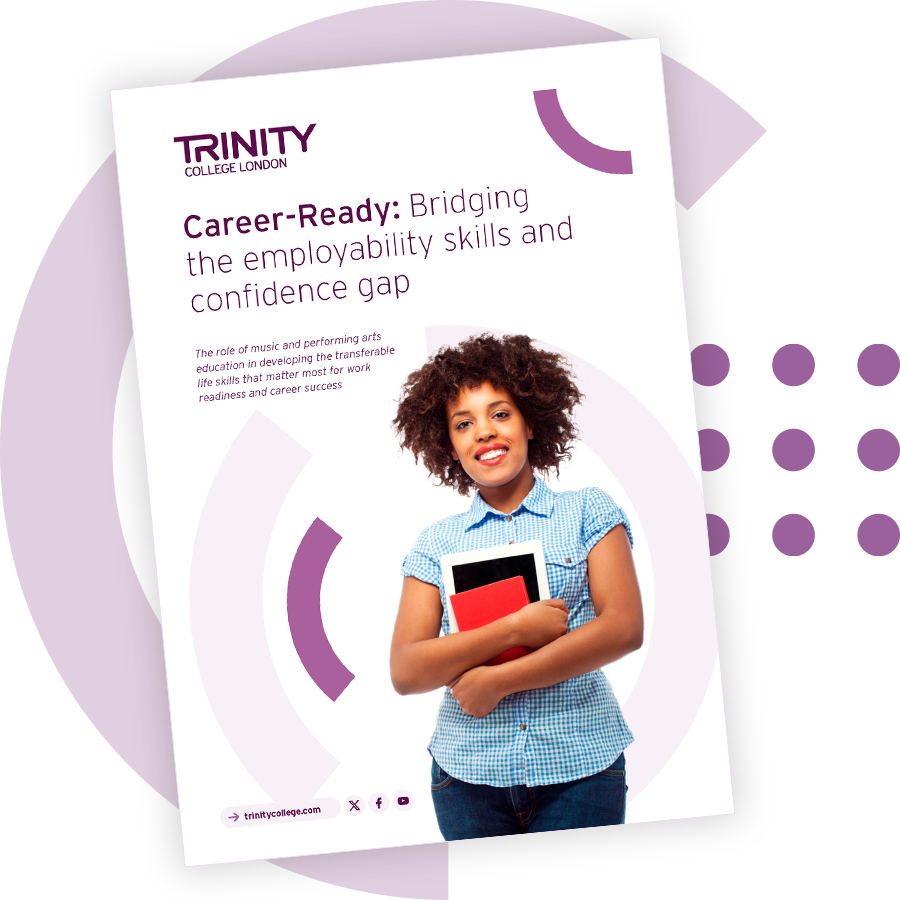
Career-Ready: Bridging the employability skills and confidence gap
Free research report out now! Click the button below to access.

How performance education builds work-readiness and confidence
Trinity College London believes that education prepares learners with the academic and technical skills, as well as transferable life skills, to thrive in the real world. Our qualifications in music, drama and English language help people develop these essential skills such as communication, collaboration, creativity and problem-solving that shape adaptable, capable people ready to succeed in study, work and life.
Trinity creates assessments that bring human skills to life, developing and evidencing skills such as creativity, problem solving and communication through performance and language. Across industries, societies and cultures, transferable life skills are now what matter most. In an age of automation and AI, the ability to think critically, express ideas clearly, work well with others and adapt to change are what distinguish confident individuals and successful organisations. At Trinity, these are the skills we have always valued and we create assessments and qualifications that develop and evidence them.
What are transferable life skills and why do they matter?
Education in the 21st century is about far more than academic attainment. It’s about equipping learners with the human capabilities to navigate uncertainty, connect across cultures and contribute meaningfully to their communities and workplaces. These are the transferable, future-focused abilities that sit alongside technical knowledge to prepare learners for success throughout life.
These skills form the foundation for every learner’s personal and professional growth through their qualification attainment. They are what employers demand, what communities need and what education must increasingly prioritise. At Trinity, they are not add-ons. They are embedded in everything we do, the principles, pedagogy and assessment models that underpin our global qualifications.
Transferable life skills include:

Communication
The confidence and clarity to express ideas and connect with others.

Creativity
The imagination to generate new ideas and the discipline to turn them into results.
Teamwork
The capacity to work effectively, listen actively and solve problems together.

Resilience
The ability to respond constructively to feedback, change and challenge.

Problem solving
The curiosity and critical thinking to analyse situations and find effective solutions.

Leadership
The confidence to motivate others, take responsibility and lead with purpose and empathy.
How Trinity’s performance and creative arts education build these skills
At Trinity College London, we have been nurturing creativity and communication for over 150 years. Today, our qualifications in music, drama and English language continue to evolve to meet the needs of a changing world, providing learners with a foundation of skills, confidence and global recognition. We believe education should develop the whole person. Trinity assessments do not only measure ability, they celebrate expression, perseverance and individuality. This focus on personal growth ensures that learners, teachers and schools can proudly demonstrate their contribution to a future-ready generation.
Performance and creative education offer a powerful and proven way to develop transferable life skills. Through music and drama learners regularly experience the very behaviours that define success in modern life: persistence, collaboration, reflection and expression.
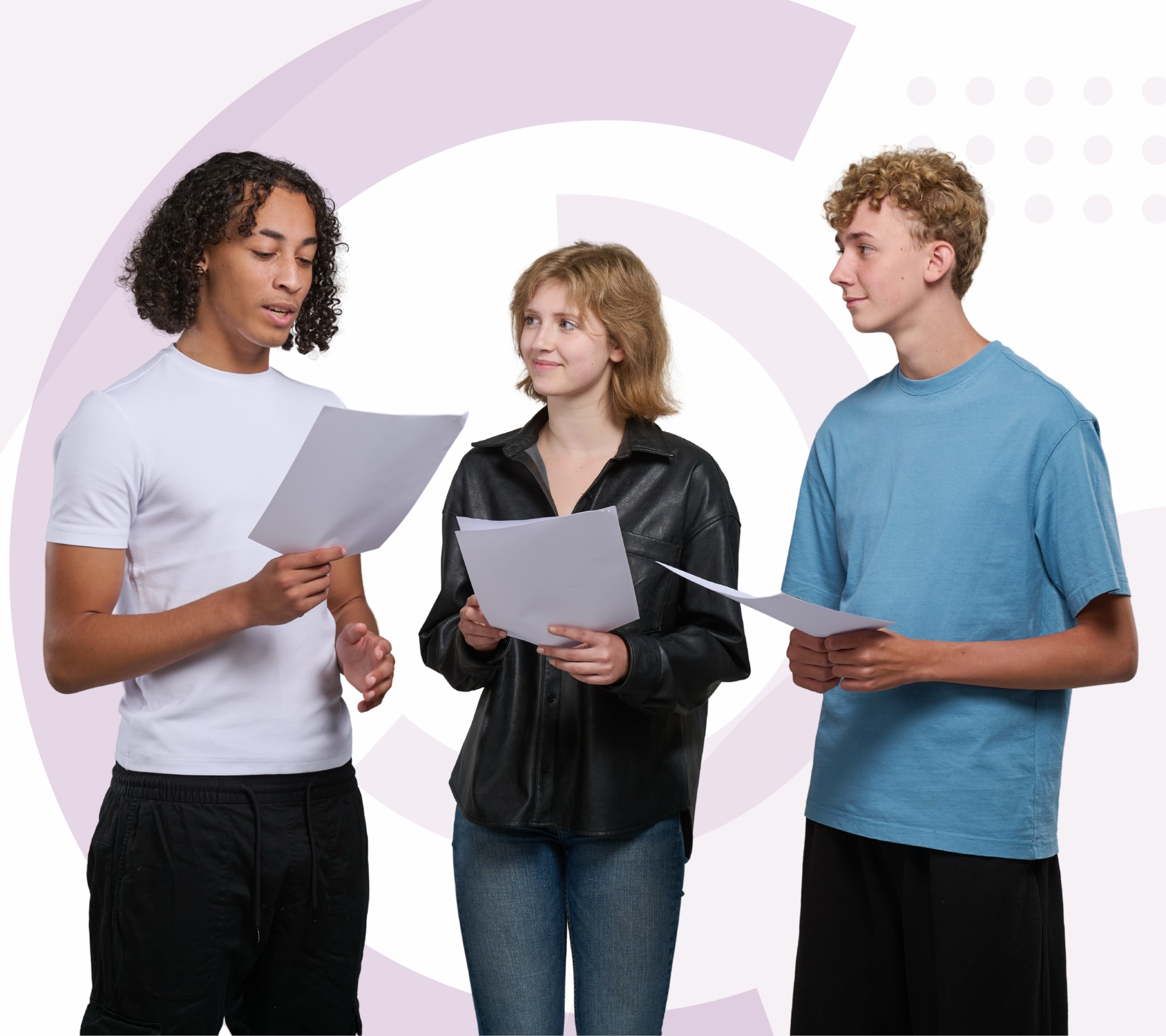
Each rehearsal, ensemble and performance gives students authentic opportunities to practise communication, teamwork and adaptability in a supportive, purpose-driven environment. They learn to:
- Listen deeply to others and respond in real time
- Express themselves with clarity, emotion and respect
- Accept and apply feedback to improve performance
- Manage pressure, time and focus to deliver their best work
- Balance independence with shared responsibility
Trinity Stories
Two Trinity exam students, Adrian and Anyaya, share how their music and drama journeys helped them develop the transferable life skills that matter most. Their stories show first hand how performance and creative learning supports young people to feel more prepared for study, work and life.
“When learners prepare for a performance, they practise the behaviours that define success: collaboration, adaptability and communication under pressure.”
Eleanor Andressen, Chief Academic Officer, Trinity College London
How Trinity College London assesses these skills
Trinity’s purpose is to help learners develop, demonstrate and gain recognition for their achievements, not only in subject knowledge, but in the skills that underpin real-world success.
Our assessments are designed around the understanding that performance is an authentic measure of transferable skills. Whether in a music recital, a drama piece or an English speaking exam, Trinity learners must think critically, communicate clearly and perform with purpose, exactly the skills employers and educators value most.
In practice:
- Music: Students build perseverance, focus and collaboration through progressive syllabuses that assess not only technical proficiency, but also interpretation, expression and ensemble awareness.
- Drama and performance: Through monologues, devised pieces and group scenes, students practise communication, empathy and adaptability, essential for leadership and teamwork in any context.
- English Language: Trinity’s communicative approach assesses fluency, confidence and real-world interaction, equipping learners in how not just to speak English but to use it effectively in study, work and life.
Each Trinity qualification provides structured, meaningful opportunities to demonstrate 21st Century Skills, transforming abstract capabilities into tangible achievement. Learners leave not just with a certificate, but with the confidence that they can apply what they know, adapt when they must and communicate who they are.
The evidence — research insights
In 2025, Trinity College London commissioned national research in the UK to explore how performance and creative education contribute to career readiness and workplace confidence. Surveys of over 2,300 young people and teachers revealed striking results:
- 65% of students who continued with creative subjects felt well-prepared for work, compared with only 46% of those who didn’t
- 96% of creative students believed they had transferable skills to succeed (vs 86% of non-creative students)
- Creative learners reported 14% lower anxiety across common workplace situations such as presenting, teamwork or receiving feedback
- 92% of teachers said creative education builds essential communication and collaboration skills
Teachers also highlighted that creative education provides structured rehearsal for life, providing spaces where learners practise listening and problem-solving in realistic contexts. This “confidence advantage” demonstrates what many educators already know intuitively: creative education nurtures the mindset, self-awareness and interpersonal fluency that underpin career success.
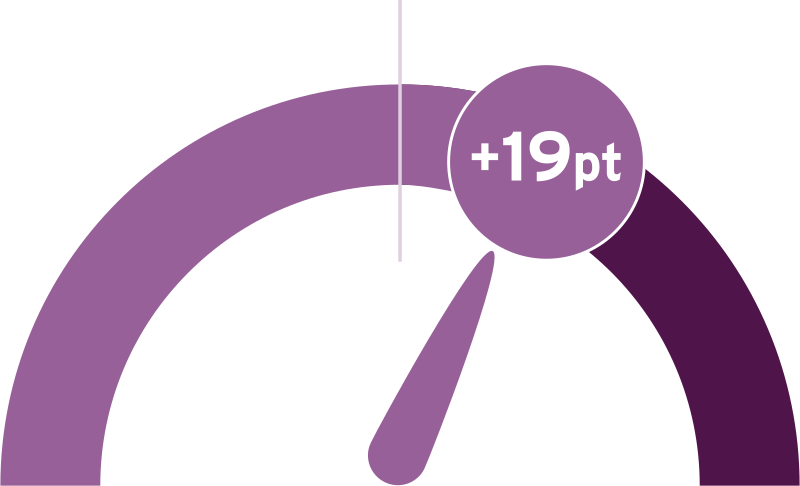
Work-readiness advantage
Performance and creative arts students feel 19 points more work-ready than their peers
New research report available now
Career-ready: Bridging the employability skills and confidence gap
Our white paper offers an in-depth look at the findings from our research, combining teacher and Gen Z perspectives with subject-level analysis and policy recommendations.
Inside, you’ll discover:
- Evidence on how performance and creative education builds the skills that employers and educators value most
- Insights into the “confidence gap” between perception and reality
- Data-driven recommendations for schools and policymakers
- How Trinity’s assessment model evidences transferable skills through authentic performance
This report provides the foundation for an international conversation about the value of creative learning in preparing the next generation for the future of work.
Read the executive summary for the top headlines.
Download the full research report
Complete the short form below to access your free copy and join our ongoing dialogue on skills, education and employability.