How can we better support speaking in the English classroom?
In many English language classrooms, speaking remains one of the most challenging skills to both develop and assess. For teachers, the question is not just what learners produce, but how they get there.
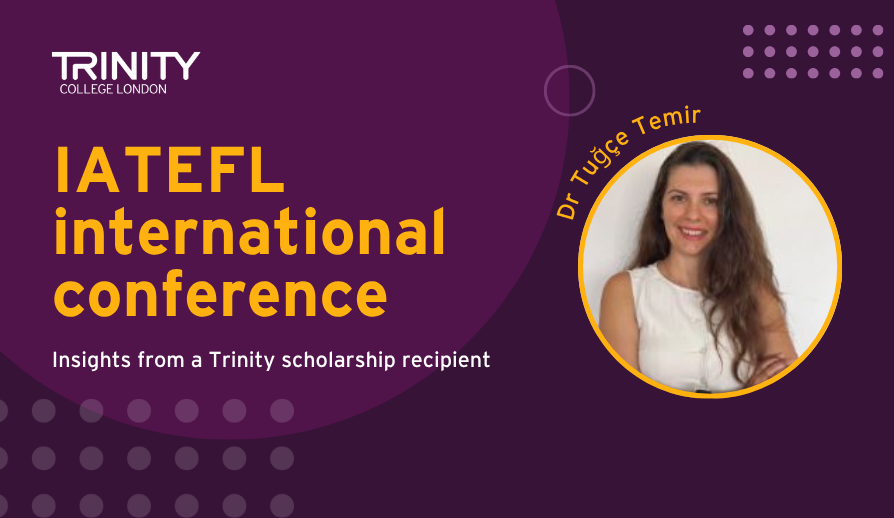
At this year’s IATEFL International Conference, a Trinity College London scholarship recipient Dr.Öğr.Üyesi Tuğçe Temir, a university-based educator from Turkey will take this question to an international audience, sharing her work on rethinking speaking through a more process-driven and interactive approach.
A focus on speaking as a process
Dr. Tuğçe Temir’s perspective is closely shaped by extensive experience in assessment, from working in testing units to her current role at university level in academic affairs. She is closely involved in assessment design, curriculum and teacher development.
This experience has led her to question how speaking is typically evaluated, and what might be missing from more traditional approaches.
“I’ve been working a lot with assessment tools, curriculum and performance assessment. Coming from that, I have the idea of focusing on performance more progress, not just outcomes, but the process of students’ learning – how they develop their speaking over time.”
Rather than focusing on what learners can demonstrate in a single moment, her work looks at how speaking develops over time through practice, interaction and ongoing support. This approach is especially important in classrooms where opportunities to practice speaking are limited.
Interaction, autonomy and the role of AI
A key part of her approach is interaction, drawing on her work in interactional competence and the value of collaborative learning.
“I’m interested in how students improve their speaking not individually, but through pair work and group work. Interactional competence is very important, and students can develop much more when they are working together.”
She has also been experimenting with how AI can support this process in practical ways. In her classroom, students worked collaboratively on speaking tasks while using AI as a resource to help develop and extend their ideas.
“They opened the AI page, shared their screen and used it as a source. They didn’t rely on it completely, but they took some information from it, added their own ideas and continued the conversation. This helped them maintain the flow of the talk much more easily”
Her current work builds on this, exploring how AI can support dynamic assessment:
“Normally the teacher mediates the talk, but I’m planning to give AI some prompts so it can help guide the interaction. In that way, students can maintain the conversation more freely and develop more autonomy.”
What this means for teachers and the wider ELT community?
Her work reflects a broader shift in ELT; moving from product-based approaches towards process-oriented, performance-based learning.
“In our country, speaking is always limited because English is a foreign language. Students don’t always have enough opportunities to practise, so I want to show that it’s not something difficult, they can improve if they are supported in the right way.”
Her work invites teachers to reflect on their own contexts and consider how speaking can be more actively developed as part of everyday learning, extending opportunities for practice beyond the classroom.
Why opportunities like this matter?
For her, presenting at IATEFL is an opportunity to share ideas, learn from others and be part of a wider professional conversation.
“I want to transfer my ideas and get theirs as well.”
Receiving the scholarship was both a personal and professional milestone, a moment of recognition that extended beyond her work into her everyday life.
“When I saw the message, I just went downstairs to tell my son and my husband…they had no idea I had even applied. Then my son asked how many people got it, and when I said around 24 from all over the world, we all got shocked. It’s a huge achievement; we shared that excitement together.”
What stands out here is not just the surprise, but the scale of the opportunity and what it represents for teachers and researchers working towards international recognition. Opportunities like this can open doors to global platforms, enabling educators to share their work, connect with peers and bring new perspectives back into their own contexts.
About the presenter
Dr.Öğr.Üyesi Tuğçe Temir is currently working at university level in Turkey, where she is involved in academic affairs, with a focus on assessment, curriculum and teacher development.
She began her career in teaching before moving into testing and curriculum work, where she developed a strong interest in how speaking is assessed. Her academic research explores interactional competence and reflective learning, particularly how students develop speaking skills through collaboration.
Her current work brings these areas together, examining how interaction, assessment and emerging technologies can better support more effective speaking development in the classroom.
With a strong commitment to global collaboration, Trinity College London continues to champion the ideas and voices driving English language teaching forward. At IATEFL, we look forward to Tuğçe Temir’s session, an inspiring opportunity to explore fresh, practical approaches to supporting speaking in the classroom.
If you’re attending IATEFL, find the session details and explore the full timetable here: Trinity College London at IATEFL 2026