Recognising SEND achievement through Performance Arts In Production exams
Author: Chloe Perry-Bartlett
Bedazzle Accessible Performance Arts Academy
Reading time: 4 mins
Over the past two years, Chloe Perry-Bartlett, Creative Arts Development Manager at Bedazzle Accessible Performance Arts Academy (BAPAA) - a UK-based inclusive performing arts school - has delivered Trinity College London Performance Arts In Production exams with learners at the academy, selecting this pathway because it fits naturally within an existing performance-led programme. With learners attending the school on different days and following varied attendance patterns, it was important to choose a qualification that recognises ensemble work, values different forms of contribution and remains straightforward to manage.
Embedding Performance Arts In Production exams within a performance-led curriculum
Acting and dance development form part of the weekly programme at BAPAA, with learners working collaboratively towards shared creative outcomes. Performance Arts In Production is embedded within the existing performance-led curriculum, recognising the work students are already doing rather than requiring separate exam preparation.
In a SEND context, this sense of recognition for all performers in a production is significant. Offering an assessment that reflects a real performance is a powerful marker of achievement, particularly where progress is not always captured by more traditional assessment routes.
Digital assessment supports this approach. Our performances are delivered to live audiences as part of the existing touring programme, which sees shows taken into primary schools and professional venues, and recordings of the performances are submitted for the Trinity exam. This keeps the focus for teachers and students on the on-stage work rather than assessment logistics.
Creating original work through a flexible syllabus
Creative decisions at BAPAA are made with inclusion in mind, starting from the strengths, needs and interests of the learners themselves. We create original material for each group, rather than relying on set texts or prescribed repertoire, allowing work to be pitched appropriately where reading level, comprehension, confidence and communication needs vary.
The flexibility of the Performance Arts syllabus supports our way of working, giving space for wide-ranging, original material that with an onus on accessibility. We shape roles around what each learner can contribute, while still working towards a shared outcome that can be formally recognised. For some learners, this provides material that can later be referenced on professional profiles, including Spotlight, as they progress.
Valuing non-verbal contribution and ensemble performance
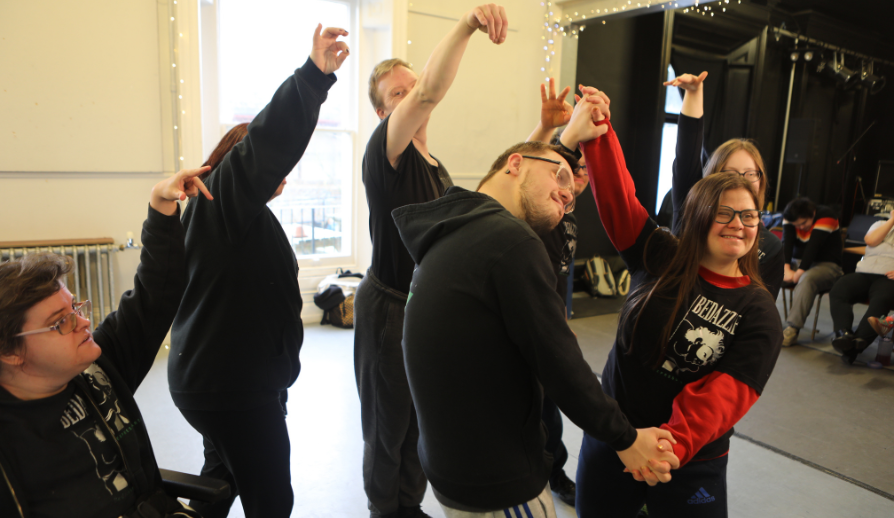
Work at BAPAA is built around ensemble practice and the belief that every learner can contribute meaningfully to a shared outcome. Productions are structured so that a range of performance skills can sit alongside one another, allowing individuals to play to their strengths.
This has enabled performances that include clowning, puppetry, mime and movement - all styles that are supported by Trinity’s Performance Arts exams. Such approaches ensure that learners with communication difficulties are fully involved and visibly successful, without their contribution depending on spoken language or line learning.
The assessment framework supports this model by recognising ensemble work and supportive, diverse styles of theatre including physical performance. Here at BAPAA, collaboration, cueing, shared focus and responsiveness are embedded within the rehearsal process and reflected in how achievement is recognised.
Confidence, communication and visible progress over time
Progress in performing arts is often most visible over time, particularly to those who are not involved day to day. External staff and venue teams have commented on increased confidence and clearer communication year on year, and parents value seeing achievement recognised through an assessment linked to real performance outcomes.
The graded exam structure provides a clear framework for demonstrating progress to local authorities and other stakeholders, without compromising a performance-led approach. This balance is crucial to our work at BAPAA. Assessment works best when it supports participation, collaboration and success on stage, rather than distracting from the creative process.
Our approach reflects this belief. Rooted in inclusion and collaboration, our work in the rehearsal room is collective and multi-skilled, shaped around the strengths each learner brings. In this way, progress is recognised not only through assessment, but through confidence, contribution and achievement that students can genuinely own.