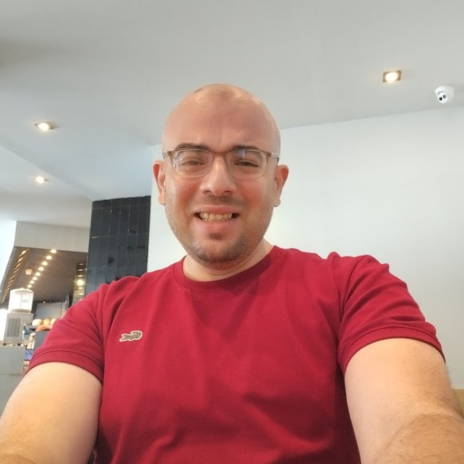
It changed the way I think about teaching: Ramy's DipTESOL journey
Name: Ramy
Location: Egypt
Trinity qualification: DipTESOL
For Ramy, studying for Trinity's Diploma in Teaching English to Speakers of Other Languages (DipTESOL) wasn't about adding another qualification to his CV. He was looking for a programme that would challenge him, deepen his understanding of teaching and help him become a more reflective practitioner.
Looking back, he says the biggest impact wasn't simply what he learned during the course. It was the questions he started asking himself every time he stepped into the classroom.
Looking for something deeper
Ramy already knew that taking on a Level 7 teaching qualification would be a significant commitment. Alongside work and other responsibilities, he wanted to be sure it would genuinely help him grow as a teacher.
"I'd started another Level 7 qualification, but I felt something was missing," he explains. "The feedback was very general, and I wanted something more specific. I wanted to know exactly what I was doing well, what I needed to improve and why."
When he joined the DipTESOL, he says that clarity was there from the very beginning.
"Since day one, everything was crystal clear. I understood the expectations, the feedback matched my performance and I always knew what I needed to work on. I never felt I was completing tasks just to pass an assessment. Everything had a purpose."
The support from his tutors also made a lasting impression.
"They were professional, knowledgeable, patient and incredibly supportive. It never felt like a mechanical process. They genuinely cared about our progress. If you weren't meeting a deadline, they wanted to know what was happening and how they could help."
For one of his research projects, a tutor even created a shared drive filled with resources tailored to his topic.
"I never felt like I was going through the course alone."
Understanding the 'why'
One area of the course that had a particularly strong impact was phonology.
"I think phonology is one of the key areas in the DipTESOL."
Working through sounds, word stress, sentence stress, connected speech and intonation gave Ramy a much deeper understanding of how pronunciation can be taught effectively. More importantly, it changed the questions he asked when planning lessons.
"It wasn't enough to identify a sound or explain a stress pattern. I had to explain why it mattered for intelligibility and why it mattered for my learners."
As an Egyptian teacher working with learners from different language backgrounds, that shift was especially valuable.
"I started thinking differently about what learners might actually find difficult. For example, if I'm teaching Arabic speakers, I need to understand why certain pronunciation features are challenging before I can decide how to teach them."
For Ramy, the course always connected theory with classroom practice.
"Everything is related to everything. You're not learning something because it's on the syllabus. You're learning it because one day you'll need to explain it, demonstrate it and apply it in your classroom."
Teaching learners, not lesson plans
Ramy completed the DipTESOL online, teaching learners from more than 20 different nationalities. Planning lessons for such a diverse group encouraged him to think carefully about every learner in the room.
"The key factor was preparing lessons that suited everyone. You can't teach exactly the same way for every learner."
One experience has stayed with him in particular.
Among his learners was Teresa, a student who is blind. Before the lesson, Ramy met with her to explain the lesson procedures and instructions. He also recorded the reading materials and shared them with her in advance so she could prepare comfortably and participate fully in the lesson.
"She was completely engaged throughout the lesson because she felt included from the beginning."
The experience changed the way Ramy thought about accessibility and differentiation.
"I learned that instructions don't always have to be given in the same way. Sometimes you need to think differently so every learner can participate."
It also reinforced one principle that continues to guide his teaching today.
"One thing I wrote down many times during the course was: don't teach the lesson plan at the cost of teaching the learners."
"The lesson plan is important, but what really matters is how learners respond to every stage, whether the instructions are working and whether learners are genuinely engaged."
The research that changed his teaching
When asked about the biggest impact the DipTESOL has had on his teaching, Ramy doesn't hesitate.
"One clear example was my awareness of teacher talk."
Before starting the diploma, he had always seen speaking less than his learners as one of his strengths.
"People used to tell me that my teacher talk was good because I spoke less than my learners. I accepted that as something positive."
The DipTESOL encouraged him to look beyond that assumption.
"I started asking myself different questions. Was it useful? Did it actually help the learners? That became the key point for me."
Through his independent research project, he recorded lessons, analysed transcripts and examined how his instructions, questions and feedback influenced learner participation.
"That changed my teaching in a very practical way."
"I realised it wasn't about reducing teacher talk for the sake of it. It was about reducing unnecessary teacher talk."
He began giving clearer instructions, waiting longer before stepping in and asking more follow-up questions. He also became more thoughtful about the feedback he gave.
"I realised that saying 'Very good' or 'Excellent' too quickly could actually close a learner's contribution instead of encouraging them to say more."
Looking back, he believes the biggest change wasn't in how much he spoke, but in how intentionally he taught.
"I stopped judging my lessons by how smoothly they went. Instead, I started looking at the evidence. How much meaningful learner interaction had I created? That, for me, was the real impact of the DipTESOL."
A professional turning point
If another teacher asked Ramy whether the DipTESOL is worth the commitment, his advice would begin with a question rather than an answer.
"I'd ask them what kind of teacher they want to become."
He believes the course is about much more than earning another qualification.
"I wouldn't describe the DipTESOL as another certificate to add to your CV. It's a professional turning point."
"It isn't easy and it will challenge you. But it changes the way you think, the way you plan, the way you analyse language, the way you observe lessons and the way you reflect on your teaching."
Looking back on his own journey, Ramy believes that's exactly what happened to him.
"Before the DipTESOL, I had experience, passion and classroom confidence. The diploma made me analyse my teaching professionally."
"I started asking better questions. Why am I using this activity? What language problem am I trying to solve? Is my teacher talk helping learners speak, or am I taking that space away from them?"
For Ramy, those questions continue to shape every lesson he teaches.
"If you only want another qualification on your CV, it's too demanding for that. But if you genuinely want to become a stronger, more reflective teacher, I would absolutely recommend it."
"For me, the DipTESOL changed the way I see teaching."
"Before the DipTESOL, I had experience, passion and classroom confidence. The diploma made me analyse my teaching professionally."
- RamyFind out more about Trinity DipTESOL
More Trinity success stories